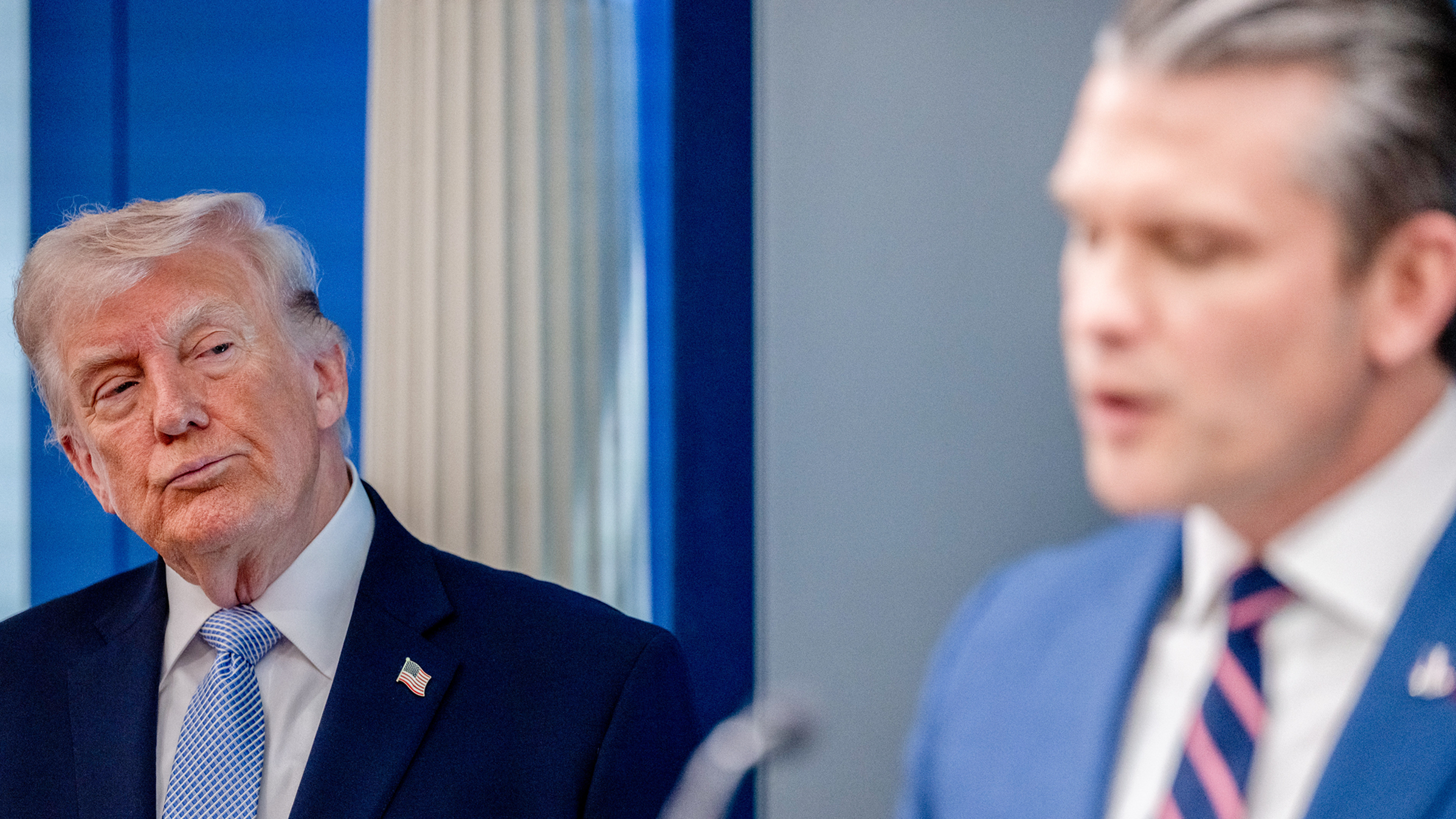
President Trump is deciding whether a resumption of strikes in Iran will finally deliver the victory he has already claimed he’s achieved. He also has two other questions to answer closer to home: Who gets the blame for a war his advisers assured him would end well before the midterms? And can he trust those same advisers when they tell him that the new plan will succeed where previous plans have failed?
Visit syntagm.co.za for more information.
For weeks, Trump has been contemplating a renewal of hostilities aimed at forcing Iran to negotiate, and advisers told us that a new round of attacks could come soon after Tuesday’s midterms. Trump has also been questioning allies about the job performances of Defense Secretary Pete Hegseth and General Dan Caine, the chairman of the Joint Chiefs of Staff, two outside advisers close to Trump told us. Hegseth and Caine have been two of Trump’s key counselors on the war. In its earliest stages, they were also among the most publicly optimistic about its prospects—although they haven’t held a press conference since May. Trump often solicits opinions from a kitchen Cabinet of friends outside his administration before making any personnel moves.
[Read: Trump’s gamble to end the Iran war]
Hegseth is not a popular figure in much of the White House. Some close to Trump suggested to us that the defense secretary has not been honest about the state of the war, which he consistently paints in rosy terms to keep Trump happy. “Hegseth is good at telling the president what he wants to hear,” said one of the outside advisers. Sean Parnell, a Pentagon spokesperson, told us in a statement that “Secretary Hegseth always provides the President and White House senior leaders the full operational picture,” calling any suggestion otherwise “dead wrong.”
The defense chief has also sought to burnish his standing with the president by pursuing those suspected of leaking to the press, one of the worst transgressions on Trump’s list of personnel offenses. Last week, Hegseth abruptly fired one of the Joint Staff’s most senior officers, Army Lieutenant General Brett Sylvia, the director of planning. Officials who work for Hegseth said Sylvia failed lie-detector tests related to the disclosure of information to reporters. Sylvia hasn’t commented and couldn’t be reached.
Hegseth had ordered Sylvia to undergo at least three polygraphs as part of a broader leak investigation after news reports earlier this year described White House conversations and details about the shortage of munitions caused by the Iran war, the officials told us. Hegseth has decided that the Joint Staff, which reports to Caine, has a problem with leaks, a contention that Caine has not forcefully pushed back on, officials told us. Hegseth’s self-portrayal to Trump allies as having the president’s back resonates with a commander in chief who, since his first term, has suspected senior Pentagon officials of insufficient loyalty.
The White House spokesperson Anna Kelly, in a statement to us, gave an endorsement of Hegseth and Caine, praising their work in reshaping the Pentagon and declaring that “President Trump and everyone at the White House have full confidence in both Secretary Hegseth and General Caine, who are fully aligned with the President’s mission.”
Caine has appeared largely out of the loop over the alleged misdeeds of one of his own senior staff. When The Atlantic first reported that Sylvia was out, the Joint Staff issued a prewritten statement that thanked Sylvia for his “32 years of distinguished service to our nation.” Caine then learned additional details from the secretary’s team about what exactly had led to Sylvia’s dismissal, while Hegseth returned from a trip from Asia, the officials told us. Hours later, Caine’s office issued a new statement that said the original “did not appropriately reflect the full circumstances.” The Joint Staff said in a statement that the chairman “does not publicly discuss these necessarily private conversations with civilian leadership” but that the process protects “unacceptable unauthorized disclosures.”
As the war has dragged on, Trump’s anger has risen over the conflict’s damage to Republicans’ midterm chances. A realization has set in at the White House that Trump is unlikely to pull out another remarkable political comeback in the midterms. The House appears gone, and the Senate may be too. Trump has raged in recent weeks that his messaging is not breaking through, and he now believes that the Iran war is at least in part to blame for his political predicament, the two advisers and an official told us. Not one to take responsibility himself, Trump is searching for a scapegoat, and has focused on those who had told him that a war with Iran would be quick and decisive.
Hegseth and Caine were both at the White House last week to present Trump and Vice President Vance with a series of options designed to create the conditions for Trump to declare victory. Admiral Brad Cooper, the top commander at U.S. Central Command, which is responsible for the military’s Middle East operations, was also at the White House last week. Trump now has to decide whether those options, and the advisers who offered them to him, are capable of bringing about a better outcome.
The military options before the president represent a series of unpalatable choices, current and former defense officials familiar with the plans told us. They give the president the chance to order strikes that would last a few hours, a few days, or several weeks. The president could also opt to maintain the U.S. naval blockade in the Strait of Hormuz while dangling the threat of a return to action. Or he could walk away.
Advocates for a resumption of strikes believe that the economic pressure campaign is working and that additional military activity would force Tehran to the negotiating table. A lengthy campaign would target Iran’s defenses, as in the war’s early days, before the U.S. shifted its strikes to concentrate on Iranian forces around the Strait of Hormuz. Iran’s infrastructure could be hit. The U.S. is expected to argue that the military is targeting infrastructure that serves both civilian and military purposes. But civilians would still be at risk. And such attacks could violate international humanitarian law. Another scenario calls for a days-long campaign against Iran’s nuclear program.
[Read: Trump is preparing for a long war]
Many within the administration expect that Israeli Prime Minister Benjamin Netanyahu, whose political fate remains uncertain after Israel’s election, would support a resumption of strikes, given his enthusiasm for the war and his belief that it would help him retain power.
Even a devastating campaign, though, might not induce concessions from Tehran. The regime could survive the attacks and celebrate its resilience after absorbing another round of U.S. firepower. After the U.S. and Israel staged a weeks-long campaign that began in late February, subsequent short strikes have only hardened Iranian resolve and prompted Tehran to lash out at U.S. assets and allies in the region. And any strike campaign would further deplete munitions stockpiles.
“If those strikes don’t work, you’ve now sort of exposed the limits of those strikes,” Michael Cohen, the director of an initiative at the Stimson Center think tank that studies whether U.S. military interventions justify their costs. “You keep hitting them and they don’t back down. So what are you going to keep doing? Keep escalating?”
Some in Trump’s orbit hope even the threat of strikes would nudge Iran back to negotiations, though that strategy has failed many times before. Last Sunday, Vance sent a letter to Mohsen Rezaei, Iran’s security chief. He proposed a resumption of direct peace negotiations, stressing that Iran’s nuclear program would have to be addressed from the outset. Vance did not say what, if anything, Tehran would get in return. The international mediators who delivered the letter pushed for a meeting later this week, around the time Trump is expected to decide on the resumption of military operations.
None of the military options appears to address threats from Iran’s proxies in the region, principally the Houthis in Yemen, who have recently launched attacks on Saudi Arabia. Eliminating those proxies was one of Trump’s stated goals for the war. New strikes also could drive oil prices higher, imposing further economic costs on the United States and its allies. One official told us that Trump’s recent turn against Ukraine was in part motivated by his desire for more Russian energy to reach international markets and offset the impact of possible U.S. military action in the Middle East. Tehran also gets a say; retaliation could escalate the conflict.
Legislators have been briefed on parts of the plans. Some were unimpressed. Senator Chris Murphy, a Democrat from Connecticut, described what he had seen as “insane.” “It will lead to devastating escalation, and the likely destruction of our commitment to the rule of law,” Murphy said last week at the Middle East Institute, a Washington think tank.
Trump has not yet given the order to resume strikes, the outside advisers and the administration official told us. If he does, he could keep the decision closely held until the last moment. In the run-up to the war, the White House didn’t inform its closest allies or seek the input of senior administration officials at the Departments of Energy and Commerce, who might have flagged the economic damage that would result from Iran’s seizure of the Strait of Hormuz, a vital waterway for global energy supplies.
At the Pentagon, planning for a possible resumption of the war is now taking place amid renewed angst over Hegseth’s purge of senior commanders. He has fired or forced out more than two dozen generals and admirals. Commanders often say their job is to keep drama away from the troops so they can focus on the mission. But Sylvia’s firing and the accusations against him prompted another round of intense chatter over what happened, who might be next, and the message the firing was intended to send. Some officials at the Pentagon told us they suspect Hegseth was seeking to weaken the Joint Staff’s standing as the president assesses what the war has wrought. Hegseth in the past has not been shy about passing the buck for the outcome of a war he promoted. Earlier this year, he reportedly told Trump at Camp David that Deputy Secretary Stephen Feinberg was responsible for the munitions shortages. (Feinberg remains in the job.)
Parnell, the Pentagon spokesperson, said Hegseth is committed to “promoting the right senior military officers to leadership positions and retiring those who are unwilling to effectively serve the only person in government elected by the whole of the American people: President Donald J. Trump.” (Service members take an oath to defend the Constitution rather than pledging allegiance to a president.)
[Read: Another top general is out at the Pentagon]
A devastating night for Republicans on Tuesday won’t necessarily reduce the chances of a resumption of hostilities, despite the war’s political toxicity. In the 2006 midterms, Democrats gained 31 seats in the House and six in the Senate, taking control of both chambers of Congress for the first time since 1994, a result widely interpreted as a repudiation of President George W. Bush’s war in Iraq. Immediately after the election, Bush blamed Defense Secretary Donald Rumsfeld for the losses and forced him out. Two months later, Bush ordered a surge of forces that ushered in one of the war’s deadliest periods.
Read full story at source